



 Aug 3, 2026
 Page Views:437


During drug development, functional cell lines are critical tools connecting drug design, in vitro functional validation, and clinical translational prediction, forming an essential foundation for drug efficacy assessment.
For drug development researchers, ideal cell lines feature qualified performance metrics and are engineered for practical R&D needs. They precisely recapitulate drug's mechanism of action (MOA), and fit multiple assay scenarios, and generate stable, reliable data as well as regulatory-supporting evidence to guide research decisions.
Focused on real-world drug discovery workflows, ACROBiosystems is committed to delivering "Application-Oriented Functional Cell Lines". Built around practical application demands, our stable, reliable, and reproducible cell line models help deliver trustworthy experimental results and accelerate drug development.
We will launch a series of application case studies to illustrate how functional cell lines benefit drug development. Content includes assay strategies, product selection, protocols and data analysis, actionable reference solutions for researchers.
For series 1, we focus on a critical scenario in antibody drug development: ADCC & ADCP functional validation.
Early Antibody Screening Based on ADCC & ADCP Functional Bioassays
1. Application
During early antibody discovery, large numbers of candidate antibodies require rapid screening to identify molecules with desirable ADCC/ADCP activities. This workflow enables researchers to accurately differentiate effector activities among antibody candidates, prioritize molecules meet predefined selection criteria, and generate high-quality functional data to support lead optimization and antibody engineering.
2. Recommended Functional Cell Lines
Reporter Cell Lines for ADCC:
Human CD16a (158V) (Luc) Jurkat Reporter Cell (Cat. No. SCJUR-STF067)
Human CD16a (158F) (Luc) Jurkat Reporter Cell (Cat. No. SCJUR-STF068)
Reporter Cell Lines for ADCP:
Human CD64 (Luc) Jurkat Reporter Cell (Cat. No. SCJUR-STF072)
Human CD32a (131H) (Luc) Jurkat Reporter Cell (Cat. No. SCJUR-STF069)
Human CD32a (131R) (Luc) Jurkat Reporter Cell (Cat. No. SCJUR-STF070)
Human CD32b (Luc) Jurkat Reporter Cell (Cat. No. SCJUR-STF071)
3. Method
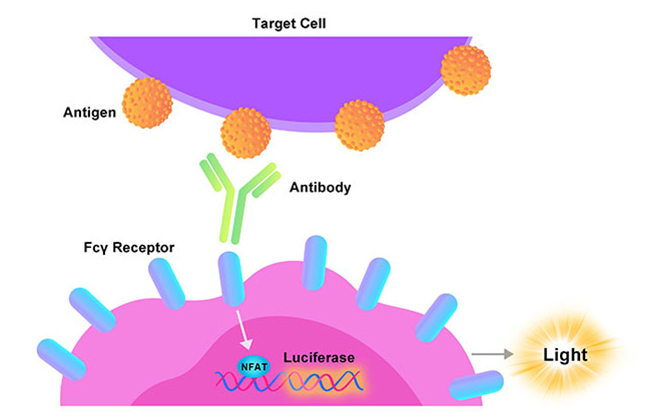
A stable target cell line expressing membrane-anchored therapeutic antigen was constructed via membrane fusion technology. Target cells were incubated with serial dilutions of two antibody candidates (Ab-1 and Ab-2), followed by the addition of the corresponding CD16a, CD32, or CD64 reporter cell lines to establish standardized in vitro ADCC/ADCP bioassays. Reporter signal activity was quantified based on relative luminescence units (RLU), enabling quantitative assessment of Fc receptor-mediated downstream signaling activation. The acquired data allowed direct comparison of Fc-mediated ADCC and ADCP effector activities between the two antibody candidates.
4. Results
ADCC Results:
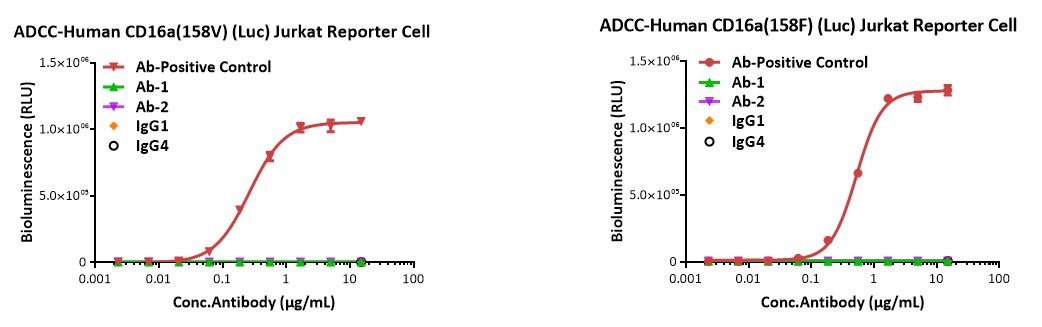
In both CD16a (158V) and CD16a (158F) reporter cell systems, Ab-1 and Ab-2 exhibited comparable RLU signals, with no significant activation of FcγR-mediated downstream signaling. The results indicate that neither candidate antibody elicited detectable ADCC effector activity.
ADCC response to Ab-1 and Ab-2 (RLU)
ADCP Results:
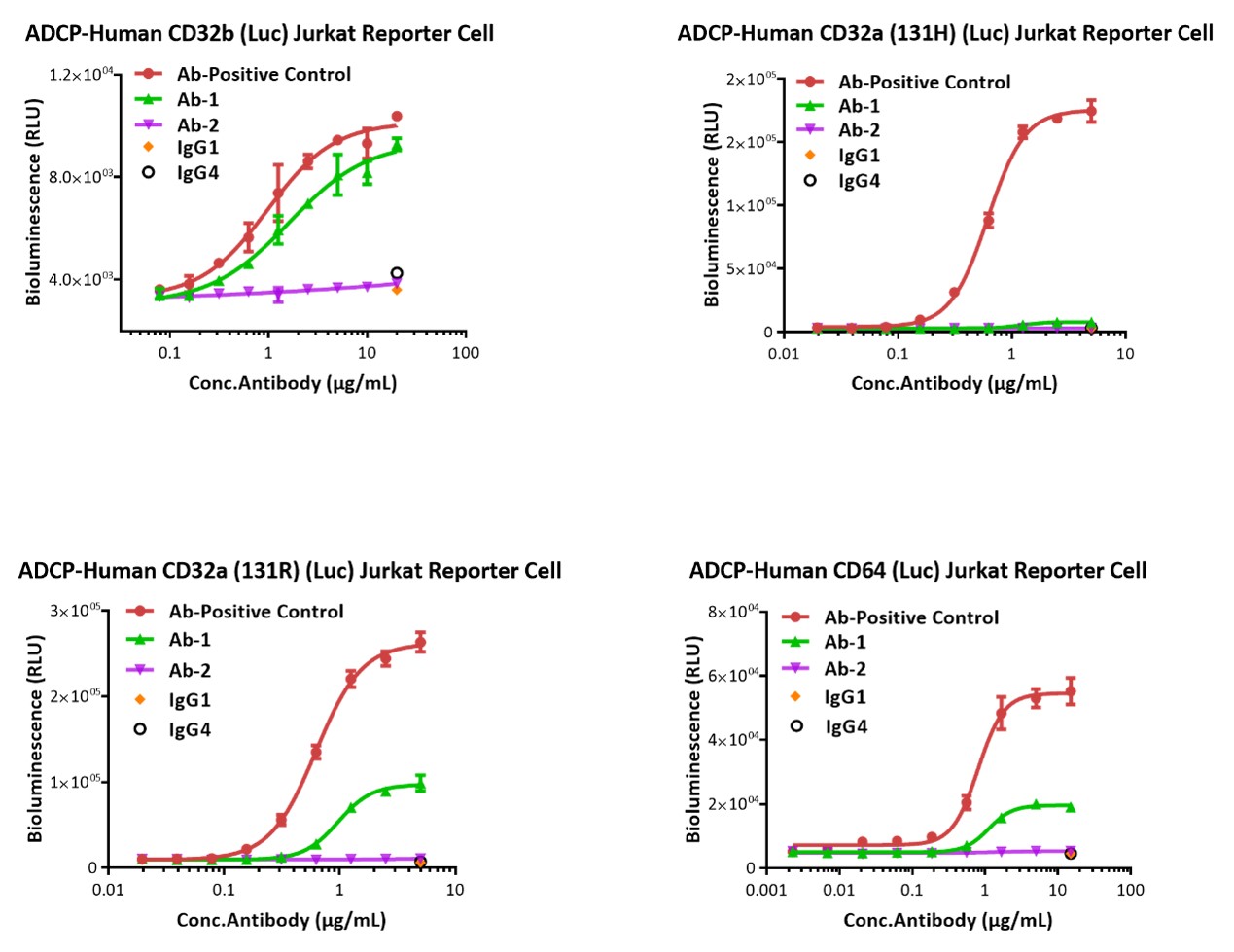
In contrast, the CD32 and CD64 reporter assay systems revealed distinct differences between Ab-1 and Ab-2. Ab-1 effectively activated downstream signaling pathways, resulting in prominent RLU elevation and robust ADCP effector activity. In comparison, Ab-2 generated minimal reporter signals, indicating negligible ADCP effector function.
ADCP response to Ab-1 and Ab-2 (RLU)
Dual evaluation of ADCC and ADCP activities clearly differentiated Fc-mediated effector functions of the two antibody candidates. The Fc receptor reporter cell panel delivers high assay sensitivity, excellent discriminatory capability, and outstanding reproducibility, making it a robust platform for antibody candidates, Fc effector function profiling, and lead candidate selection during the early stage of antibody drug development.
Evaluating the Impact of Payload Conjugation of ADC on Fc-Mediated ADCC Activity Using Reporter Cell Lines
1. Application
An Antibody-Drug Conjugate (ADC) consists of three core components: a monoclonal antibody, a cytotoxic payload, and a chemical linker. Payload conjugation may alter the spatial conformation of the antibody Fc region, thereby influencing its interaction with FcγRs. Such subtle functional changes are often undetectable by conventional protein binding assays.
In this case study, CD16a reporter cell line was used to compare the ADCC activities of ADC drug and its corresponding naked antibody, enabling direct functional evaluation of how payload conjugation modulates Fc-mediated ADCC effector function.
2. Recommended Functional Cell Lines
Reporter Cell Line for ADCC:
Human CD16a (158V) (Luc) Jurkat Reporter Cell (Cat. No. SCJUR-STF067)
3. Method
Cell-based assay serves as a more reliable approach to identify altered Fc effector activities upon payload conjugation. Serial dilutions of the ADC, its corresponding naked antibody, and isotype control were incubated with CD16a reporter cells. Luciferase activity was measured in RLU to assess ADCC pathway activation, enabling direct cell-based comparison of Fc-mediated effector function between ADCs and their corresponding naked antibodies.
4. Results
Both ADCs and their corresponding naked antibodies triggered reporter signaling pathway activation with measurable ADCC effector function. However, payload conjugation exerted significantly different impacts on Fc-mediated effector function across distinct ADC molecules.
- ADC1 showed significantly reduced ADCC activity compared with its corresponding naked antibody, indicating that payload conjugation of ADC1 markedly inhibits Fc-mediated effector function.
- ADC2 exhibited similar ADCC activity compared with its corresponding naked antibody, indicating that payload conjugation of ADC2 had minimal impact on Fc-mediated ADCC effector function.
These results confirm that payload conjugation differentially modulates ADC Fc-mediated ADCC effector function in a molecule-dependent manner. The CD16a reporter cell line offers a highly sensitive, robust, and reproducible platform for detecting subtle changes in Fc-mediated effector function induced by payload conjugation, supporting Fc optimization, and functional quality assessment.
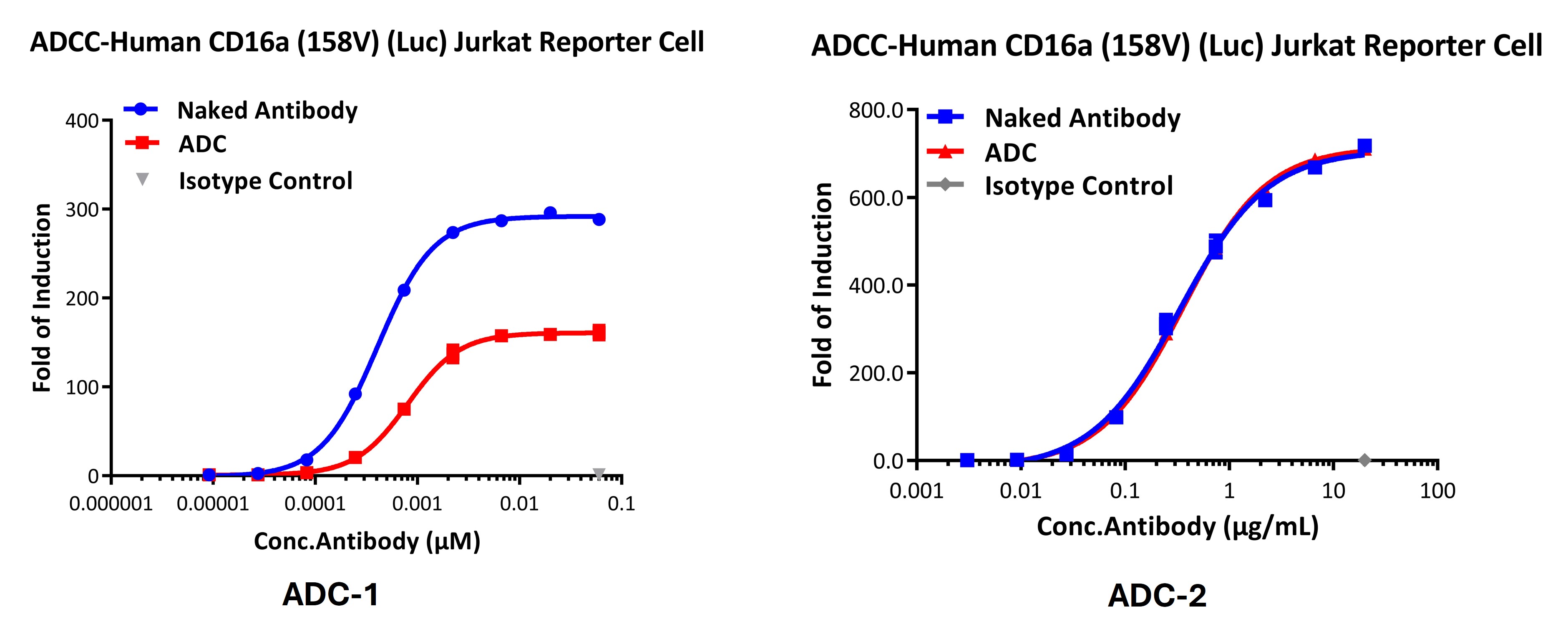
ADCC response to ADCs and Naked Antibodies (RLU)
Conclusion
This series of case studies demonstrate that ACROBiosystems' ADCC & ADCP reporter cell lines enable sensitive, robust, and reproducible assessment of antibody-mediated ADCC and ADCP activities. These reporter cell lines not only clearly distinguish differences in ADCC and ADCP activities among antibody candidates but also sensitively detect subtle changes in Fc-mediated effector function induced by payload conjugation, enabling accurate, reproducible and biologically relevant functional characterization.
The standardized workflow is fully adaptable to diverse antibody development programs, providing a comprehensive solution for early-stage antibody screening, Fc engineering, functional potency evaluation, and preclinical functional characterization. By delivering consistent and repeatable functional data, ACROBiosystems accelerate antibody drug development with greater confidence.
Moving forward, we will continue to expand Application-Oriented Functional Cell Lines Case Study Series covering more drug development scenarios, standardized assay protocols, practical product selection guidance, and real experimental data.
We welcome your feedback on future research topics and technical challenges. Stay tuned for more application-driven case studies tailored to your drug development needs.
FAQ
Q1: What are ADCC and ADCP, and why are they important in antibody drug development?
A: ADCC (Antibody-Dependent Cellular Cytotoxicity) and ADCP (Antibody-Dependent Cellular Phagocytosis) are important Fc-mediated immune effector functions that contribute to the therapeutic activity of many antibody drugs. Evaluating both activities helps researchers characterize antibody candidates, compare Fc-mediated functions, and support lead candidate selection during early-stage antibody development.
Q2: How are reporter cell lines used to evaluate ADCC and ADCP activity?
A: Fc receptor reporter cell lines use engineered immune effector cells to detect signaling triggered by Fc receptor activation. CD16a reporter cells can be used to evaluate ADCC activity, while CD32 and CD64 reporter cells support ADCP-related functional assessment. Luciferase-generated relative luminescence units (RLU) provide a quantitative readout for comparing Fc-mediated effector activity.
Q3: How can ADCC and ADCP assays help screen antibody candidates?
A: ADCC and ADCP reporter assays enable researchers to quantitatively compare Fc-mediated effector functions among antibody candidates. By evaluating both pathways, researchers can identify differences in functional activity, prioritize candidates with desirable profiles, and generate reproducible data to support lead optimization and antibody engineering.
Q4: Can ADC payload conjugation affect Fc-mediated ADCC activity?
A: Yes. ADC payload conjugation can affect Fc-mediated ADCC activity by altering the antibody's structure, FcγRIIIa (CD16a) binding, or Fc accessibility. The impact depends on factors such as the conjugation site, linker chemistry, and drug-to-antibody ratio (DAR). Therefore, ADCC activity should be evaluated during ADC characterization using appropriate cell-based functional assays.
Q5: What are the advantages of Fc receptor reporter cell lines for antibody functional characterization?
A: Fc receptor reporter cell lines provide sensitive, quantitative, and reproducible functional measurements of Fc-mediated signaling. They can support antibody screening, ADCC and ADCP profiling, Fc engineering, functional potency evaluation, and preclinical characterization across different antibody development programs.