

Human CCL17 / TARC Protein, Tag Free (HPLC verified)

製品番号/仕様
価格
Availability
数量
CC7-H5113-20ug
$185.00
In Stock - Delivery on Nov. 17, 2026.
CC7-H5113-50ug
$370.00
In Stock - Delivery on Nov. 17, 2026.
CC7-H5113-1mg (200ug X 5)
$3,090.00
CC7-H5113
製品金額 :
$ 0
推奨新製品 Request Quote
Contact Us
Contact Us
製品金額:
$ 0
  • 製品詳細
  • データ表示
  • Reviews & Citations
  • Important Statement
  • Resources
Synonyms

TARC, ABCD-2, SCYA17, A-152E5.3

Source

Human CCL17 Protein, Tag Free (CC7-H5113) is expressed from E. coli cells. It contains AA Ala 24 - Ser 94 (Accession # Q92583).

Predicted N-terminus: Ala 24

Molecular Characterization

This protein carries no "tag".

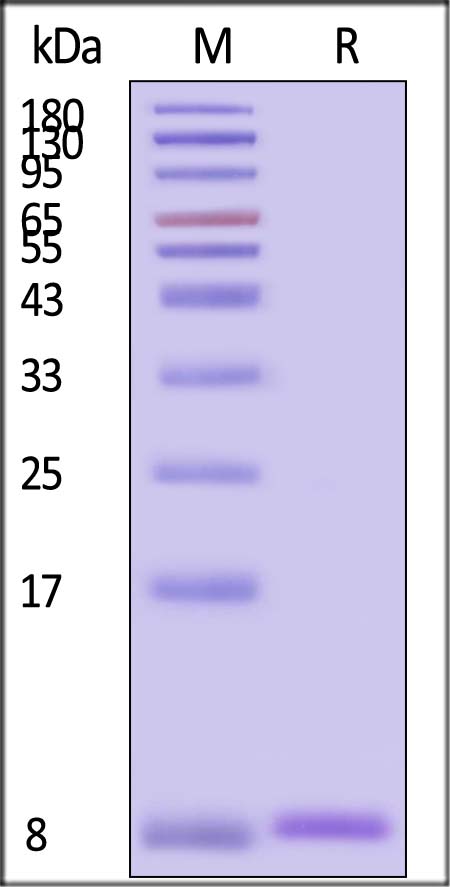
The protein has a calculated MW of 8.1 kDa. The protein migrates as 8 kDa when calibrated against Star Ribbon Pre-stained Protein Marker under reducing (R) condition (SDS-PAGE).

Purity

>90% as determined by SDS-PAGE.

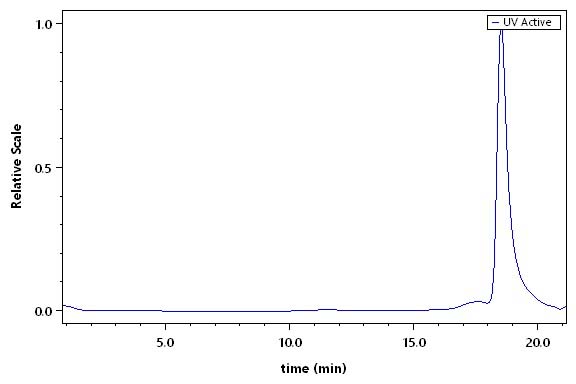
>90% as determined by SEC-HPLC.

Formulation

Lyophilized from 0.22 μm filtered solution in PBS, pH7.4, 0.5 M Arginine with trehalose as protectant.

Contact us for customized product form or formulation.

Reconstitution

Please see Certificate of Analysis for specific instructions.

For best performance, we strongly recommend you to follow the reconstitution protocol provided in the CoA.

Shipping and Storage

This product is shipped at ambient temperature.

For long term storage, the product should be stored at lyophilized state at -20°C or lower.

Please avoid repeated freeze-thaw cycles.

This product is stable after storage at:
  • -20°C to -70°C for 12 months in lyophilized state;
  • -70°C for 3 months under sterile conditions after reconstitution.

バックグランド

This antimicrobial gene is one of several Cys-Cys (CC) cytokine genes clustered on the q arm of chromosome 16. Cytokines are a family of secreted proteins involved in immunoregulatory and inflammatory processes. The CC cytokines are proteins characterized by two adjacent cysteines. The cytokine encoded by this gene displays chemotactic activity for T lymphocytes, but not monocytes or granulocytes. The product of this gene binds to chemokine receptors CCR4 and CCR8. This chemokine plays important roles in T cell development in thymus as well as in trafficking and activation of mature T cells.

ACRO Scientific Leadership Award

Supporting the scientists driving cell & gene therapy forward

Apply Now