
GENIUS™NucleaseDMF

Customer Reviews
Cat. No. / Size
Price
Qty
BEE-N3116-500KU (250KU × 2)
$955.00
BEE-N3116-50KU
$215.00
BEE-N3116-10KU
$110.00
ETA of in-stock products:2 business days

Product Details

  • Enzyme Features

    1. Generally usable: Generally usable for removing all forms of DNA and RNA from biological products, reducing viscosity and preventing cell clumping.
    2. Efficient: Efficient reaction, rapid degradation, reduce processing time.
    3. Native: Native structure, tag free, the enzyme activity is more guaranteed.
    4. Ideal: Ideal for DNA and RNA clearance
    5. Ultra pure: Ultra pure: High purity and activity
    6. Specific: Specific nuclease, no protease activity

  • Description

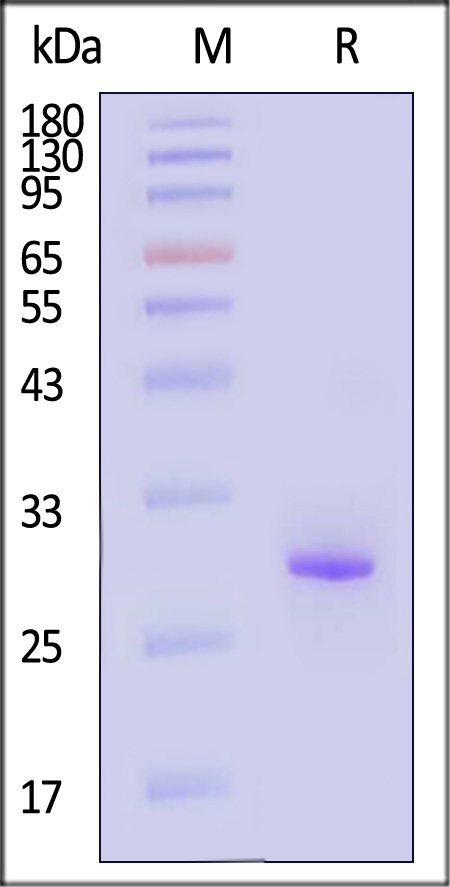
    GENIUS™Nuclease is a recombinant form of Serratia marcescens extracellular endonuclease produced in Escherichia coli cells using a proprietary process at ACROBiosystems. GENIUS™Nuclease is a homodimer with monomer molecular masses about 30 kDa. Two disulfide bonds found in the nuclease are crucial to its activity and stability. The enzyme is a non-specific nuclease with high specific activity, which degrades both single- and double-stranded nucleic acids in any form ( single stranded, double stranded, linear, circular and supercoiled). It hydrolyzes internal phosphodiester bonds present between the nucleotides to 5‘- phosphorylated oligonucleotides of 3-5 bases in length.

  • Application

    Its high intrinsic activity and broad substrate tolerance make the endonuclease an ideal tool in a variety of biotechnological applications: removal of nucleic acid from protein samples ( Elimination of nucleic acids from recombinant proteins; Purification of protein fragments from inclusion bodies; Sample preparation in western blotting or two- dimensional gel electrophoresis) ; Viscosity reduction in protein extracts.

  • Effect of Conditions on Activity

    GENIUS™Nuclease is functional between pH 6 and 10 (optimal at pH8 - 8.5) , and from 0℃ to 42 ℃ (optimal at 35 ℃ - 42 ℃). Mg2+ (1-2 mM) is required for enzyme activity. 1 mM EDTA reduced the activity by 30% in the presence of 1 mM MgCl2; 0.1 M EDTA eliminated all enzyme activity. In the presence of 1 mM MgCl2, enzyme levels were reduced 75% by 0.1 M CaCl2 or 1 M NaCl. Under standard assay conditions, 1 mM iodoacetate had no effect on the enzymatic rate, whereas 1 mM mercaptoethanol and maleic acid reduced the activity by only 5 to 10%. 10 mM p- Chloromercurybenzoate completely inactivates the enzyme, while 0.64 M beta-mercaptoethanol in the presence of 2 M urea causes only partial inactivation of the enzyme. 4 or 7 M Urea increases the enzyme activity.

  • Removal of GENIUS™Nuclease

    GENIUS™Nuclease contain no “Tag” and used in downstream processing can be removed by various purification methods according to the purification strategy for the target protein.

  • Unit Definition

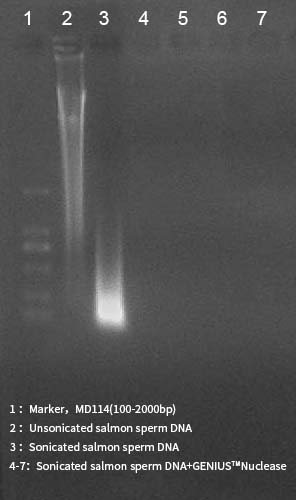
    One unit will digest sonicated salmon sperm DNA to acid-soluble oligonucleotides equivalent to a ΔA260 of 1.0 in 30 min at pH 8.0 at 37 ℃, which corresponds approximately to complete digestion of 37 μg DNA. Note that 1 KU=1000 units.

  • Formulation

    Lyophilized in Tris HCl, pH 8.0, MgCl2, and NaCl.

  • Purity

    >95% as determined by SDS-PAGE reduced GENIUS™Nuclease.

  • Enzyme Activity

    >250U/μL

  • Activity Assay Procedure

    1. Reagents and solutions preparation
    Reaction buffer*:
    50 mM Tris-HCl, 1 mM MgCl2, pH 8.0 ( * In the case of extensive dilution before use, carrier protein such as 0.1 mg/ml HSA or BSA is generally recommended to avoid any enzyme loss from surface adsorption)
    DNA Substrate:
    1 mg/ml salmon sperm DNA is dissolved overnight at 4 ℃, in reaction buffer, and is then sonicated on ice to obtain a homogenous solution.
    Enzyme:
    Different dilution of nuclease with reaction buffer.
    Stop reagent:
    Trichloroacetic acid (TCA)

    2. Standard curve establishment
    400 μl substrate + 100 μl enzyme of known activity = 500 μl mixture

    1. Incubate the mixture at 37℃ for 30 min.
    2. Stop the reaction by addition of 400 μl cold TCA and incubate on ice for 10 min.
    3. Centrifuge at 8500g for 5 min.
    4. Measure the absorbance of supernatant at 260 nm.
    5. Lot a standard curve with nuclease of known activities for each set of measurements.

    3. Measurement of activity
    The activity of any unknown nuclease can be determined from a single measurement by means of the standard curve. The specific activity of GENIUS™Nuclease is >1.0 x 10e6 unit/mg protein.

  • Activity

    4-1BB Structure

    Standard curve of nuclease activity for GENIUS™Nuclease.

  • Reconstitution

    See Certificate of Analysis for reconstitution instructions and specific concentrations.

  • Storage

    This product is stable after storage at:
    In lyophilized state for 1 year (-20℃); After reconstitution under sterile conditions for 3 months (-70℃).

  • ACRO Quality Management System

    1. QMS(ISO, GMP)
    2. Quality Advantages
    3. Quality Control Process
  • Notice: We updated the brand name from Benz™Nuclease to GENIUS™Nuclease. The products are the same and the only change is the brand name in the product name and the label.

Customers Also Viewed

Performance Data

  • SDS-PAGE

    BEE-N3116 SDS-PAGE

    GENIUS™Nuclease on SDS-PAGE under reducing (R) condition. The gel was stained with Coomassie Blue. The purity of the protein is greater than 95% (With Star Ribbon Pre-stained Protein Marker).

  • Application example

    BEE-N3116 application

    The result of GENIUS™Nuclease activity.

Customer Reviews
Writing Reviews

Recent Advances

 
Contact Us
Drug Candidate Licensing
More
  • Basic Product Information
  • Product Details
  • Customers Also Viewed
  • Performance Data
  • Customer Reviews
Contact Us

お問い合わせ
グローバル:+1 800-810-0816(Toll Free)

メールアドレス
order.jp@acrobiosystems.com

アクロバイオシステムズ株式会社
〒101-0051
東京都千代田区神田神保町1-32-8