


Biotinylated Human NY-ESO-1 TCR & CD3E & CD3D & CD3G & CD3Z Full Length Protein, His,Flag&Avitag™ (Nanodisc)

Customer Reviews
Cat. No. / Size
Price
Qty
NYZ-H82D3-20ug
$1020.00
NYZ-H82D3-100ug
$1820.00
ETA of in-stock products:2 business days

Product Details

  • Application

    1. Cell based assay (FACS or functional assay)
    2. Affinity testing (SPR / BLI)
    3. Screening (ELISA)
  • Synonyms

    NY-ESO-1 TCR & CD3E & CD3D & CD3G & CD3Z

  • Source

    Nanodisc Biotinylated Human NY-ESO-1 TCR & CD3 Full Length Protein, His,Flag&Avitag (NYZ-H82D3) is expressed from human 293 cells (HEK293). It contains AA (Accession # P07766-1 & P04234-1 & P09693-1 & P20963-1).

    Predicted N-terminus: Phe

  • Molecular Characterization

    The protein has a calculated MW of 67.0 kDa & 80.2 kDa. The protein migrates as 43 kDa,55 kDa,65-70 kDa and 95 kDa when calibrated against Star Ribbon Pre-stained Protein Marker under reducing (R) condition (SDS-PAGE) due to glycosylation.

    *The isotype control of empty/mock nanodisc (Cat. No. APO-H81Q5) is sold separately and not included in protein, you can follow the link for product information.
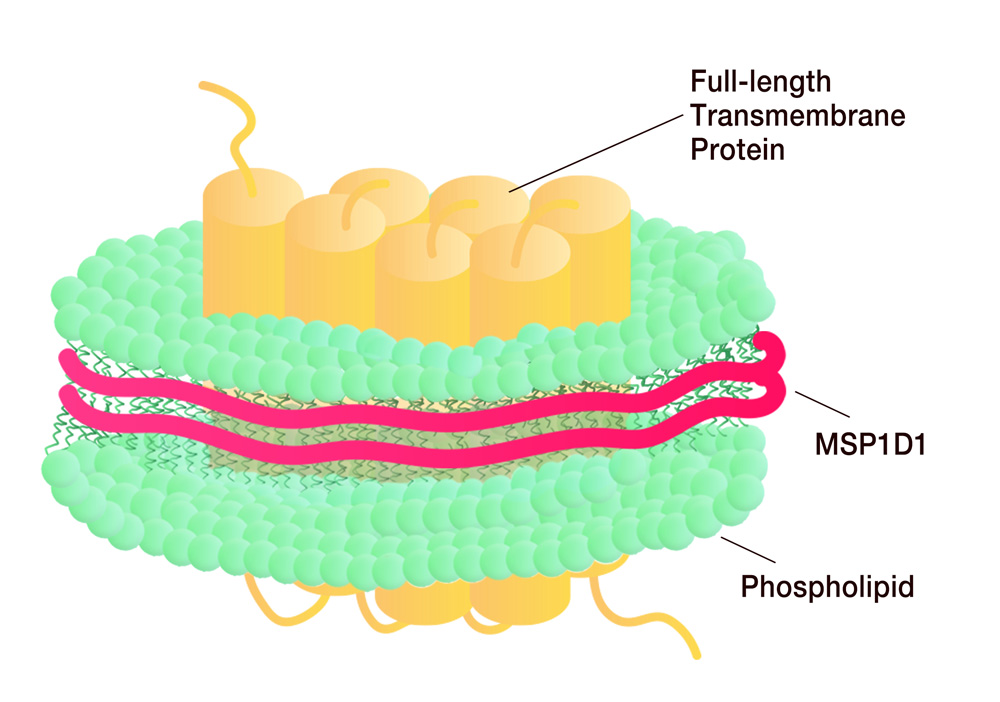
    1. Structure

      Nanodisc membrane protein is wrapped by a synthetic phospholipid bilayer membrane structure, composed of membrane scaffold proteins (MSPs) and phospholipids.

    2. Synthesis Process

      Nanodisc reconstitution is a self-assembly process that starts from purified, detergent-solubilized membrane proteins and reconstitutes them into synthetic phospholipid bilayers stabilized by MSP1D1 membrane scaffold protein. This creates a stable, detergent-free environment that preserves native conformation and biological activity, with excellent homogeneity and full compatibility with cell-based assays such as FACS and binding assays in antibody discovery and screening (ELISA),etc.

  • Labeling

    Biotinylation of this product is performed using Avitag™ technology. Briefly, the single lysine residue in the Avitag is enzymatically labeled with biotin.

  • Protein Ratio

    Passed as determined by the HABA assay / binding ELISA.

  • Endotoxin

    Less than 1.0 EU per μg by the LAL method / rFC method.

  • Purity

    >90% as determined by SDS-PAGE.

  • Formulation

    Supplied as 0.2 μm filtered solution in 20 mM HEPES, 150 mM NaCl, pH7.5 with glycerol as protectant.

    Contact us for customized product form or formulation.

  • Shipping and Storage

    This product is supplied and shipped on dry ice.

    Please avoid repeated freeze-thaw cycles.

    This product is stable after storage at:

    1. The product MUST be stored at -70°C or lower upon receipt;
    2. -70°C for 3 months under sterile conditions.
  • ACRO Quality Management System

    1. QMS(ISO, GMP)
    2. Quality Advantages
    3. Quality Control Process

Customers Also Viewed

Performance Data

  • SDS-PAGE

    NY-ESO-1 TCR & CD3E & CD3D & CD3G & CD3Z SDS-PAGE

    Biotinylated Human NY-ESO-1 TCR & CD3 Full Length Protein, His,Flag&Avitag on SDS-PAGE under reducing (R) condition. The gel was stained with Coomassie Blue. The purity of the protein is greater than 90% (With Star Ribbon Pre-stained Protein Marker).

  • Bioactivity-ELISA

     NY-ESO-1 TCR & CD3E & CD3D & CD3G & CD3Z ELISA

    Immobilized Biotinylated Human NY-ESO-1 TCR & CD3 Full Length Protein, His,Flag&Avitag (Cat. No. NYZ-H82D3) at 5 μg/mL (100 μL/well) on streptavidin (Cat. No. STN-N5116) precoated (0.5 μg/well) plate can bind Monoclonal Anti-Human CD3 Antibody, Mouse IgG2a (Clone: OKT3), premium grade (Cat. No. CDE-M120a) with a linear range of 0.05-3 ng/mL (QC tested).

    Protocol
  • Bioactivity-SPR

     NY-ESO-1 TCR & CD3E & CD3D & CD3G & CD3Z SPR

    Biotinylated Human NY-ESO-1 TCR & CD3 Full Length Protein, His,Flag&Avitag (Cat. No. NYZ-H82D3) immobilized on SA Chip can bind Unconjugated Human HLA-A*02:01&B2M&NY-ESO-1 (SLLMWITQC) Complex Protein (Cat. No. HL1-H82Ea) with an affinity constant of 1.04 μM as determined in a SPR assay (Biacore 8K) (Routinely tested).

    Protocol

Customer Reviews
Writing Reviews

Background

Cluster of Differentiation 3 (CD3) is a pivotal multimeric T cell co-receptor complex essential for adaptive immune responses. Composed of epsilon (ε), gamma (γ), delta (δ), and zeta (ζ) polypeptide chains forming three distinct dimers (εγ, εδ, ζζ), CD3 non-covalently associates with the T-cell receptor (TCR) to establish the critical TCR/CD3 receptor complex on T cell surfaces. Structurally, CD3 proteins belong to the immunoglobulin superfamily, featuring a transmembrane domain, an N-terminal extracellular region with immunoglobulin-like domains, and cytoplasmic tails embedded with immunoreceptor tyrosine-based activation motifs (ITAMs). These ITAMs are fundamental for initiating signal transduction upon T cell receptor engagement, thereby activating both CD4+ T helper and CD8+ cytotoxic T cells. As a defining marker of the T cell lineage, CD3's central role in T cell activation makes its modulation, via stimulating or blocking antibodies, a promising therapeutic avenue for conditions like organ transplant rejection and autoimmune diseases.

Recent Advances

 
Contact Us
Drug Candidate Licensing
More
  • Basic Product Information
  • Product Details
  • Customers Also Viewed
  • Performance Data
  • Customer Reviews
  • Background
Contact Us

お問い合わせ
グローバル:+1 800-810-0816(Toll Free)

メールアドレス
order.jp@acrobiosystems.com

アクロバイオシステムズ株式会社
〒101-0051
東京都千代田区神田神保町1-32-8