



Anti-idiotypic Antibodies
Anti-idiotypic (Anti-ID) antibodies recognize unique epitopes in the variable region of a therapeutic antibody. In pharmacokinetic (PK) assays, they can be used as capture or detection reagents for drug-specific quantification in biological samples. For anti-drug antibody (ADA) assays, drug-specific anti-ID antibodies can provide positive controls for immunogenicity assay development and evaluation.
ACROBiosystems offers anti-idiotypic antibodies for a range of therapeutic antibodies, including adalimumab, rituximab, cetuximab, trastuzumab, and bevacizumab. Application data and assay protocols are available to support product selection and method development.
Anti-idiotypic Antibody Products List
| Cat. No. | Target | Drug Name | Product Description | Order Now |
|---|---|---|---|---|
TNF-α TNF-α |  Order Order | |||
TNF-α TNF-α | Order | |||
TNF-α TNF-α | Order | |||
BCMA BCMA | Order | |||
BCMA BCMA | Order | |||
BCMA BCMA | Order | |||
BCMA BCMA | Order | |||
VEGF-A VEGF-A | Order | |||
VEGF-A VEGF-A | Order | |||
VEGF-A VEGF-A | Order | |||
VEGF-A VEGF-A | Order | |||
EGF R EGF R | Order | |||
EGF R EGF R | Order | |||
EGF R EGF R | Order | |||
EGF R EGF R | Order | |||
EGF R EGF R | Order | |||
TROP-2 TROP-2 | Order | |||
TROP-2 TROP-2 | Order | |||
TROP-2 TROP-2 | Order | |||
TROP-2 TROP-2 | Order | |||
Her2 Her2 | Order | |||
Her2 Her2 | Order | |||
Her2 Her2 | Order | |||
Nectin-4 Nectin-4 | Order | |||
Nectin-4 Nectin-4 | Order | |||
Her2 Her2 | Order | |||
Her2 Her2 | Order | |||
Her2 Her2 | Order | |||
Her2 Her2 | Order | |||
Siglec-2 Siglec-2 | Order | |||
Siglec-2 Siglec-2 | Order | |||
Siglec-2 Siglec-2 | Order | |||
CD79B CD79B | Order | |||
CD79B CD79B | Order | |||
CD79B CD79B | Order | |||
CD20 CD20 | Order | |||
CD20 CD20 | Order | |||
CD20 CD20 | Order | |||
TROP-2 TROP-2 | Order | |||
TROP-2 TROP-2 | Order | |||
TROP-2 TROP-2 | Order | |||
Her2 Her2 | Order | |||
Her2 Her2 | Order | |||
Her2 Her2 | Order |
Two Key Applications
- Application 1: Drug-Specific Quantification for PK Analysis
- Application 2: Drug-Specific Positive Controls for ADA Assays
Application 1: Drug-Specific Quantification for PK Analysis
Total antibody drug: Antigen non-blocking anti-idiotypic antibodies can detect the therapeutic antibody across free and target-bound forms.
Target-bound drug: Antibodies that specifically recognize the therapeutic antibody–target complex are used to detect the bound form.

Detection of rituximab by bridging ELISA in serum. Immobilized Anti-Rituximab Antibodies (Cat. No. RIB-Y37) at 2 μg/ml, added increasing concentrations of Rituximab (10% human serum) and then added biotinylated Anti-Rituximab Antibodies (Cat. No. RIB-BY35) at 1 μg/ml. Detection was performed using HRP-conjugated streptavidin with a sensitivity of 1 ng/ml.


Comparison between anti-idiotypic capture ELISA and anti-idiotypic bridging ELISA for rituximab detection in patient samples.Left: anti-idiotypic capture ELISA; Right: anti-idiotypic bridging ELISA.
Application 2: Drug-Specific Positive Controls for ADA Assays

Anti-Rituximab Antibodies bridging ELISA for Anti-Drug Antibody (ADA) assay development. Immobilized rituximab at 1 µg/ml, added increasing concentrations of Anti-Rituximab Antibodies (Cat. No. RIB-Y36, 10% human serum) and then added biotinylated rituximab at 2 µg/ml. Detection was performed using HRP-conjugated streptavidin with a sensitivity of 9.7 ng/mL.

Anti-Rituximab Antibodies bridging MSD for Anti-Drug Antibody (ADA) assay development. Added the mix solution (biotinylated Rituximab at 5 µg/mL, SULFO-Rituximab at 5Nµg/mL and increasing concentrations of Anti-Rituximab Antibodies (Cat. No. RIB-Y36, 100% human serum). Detection was performed using MSD Assay with a sensitivity of 0.97 ng/mL.

Anti-Adalimumab Antibodies bridging ELISA for Anti-Drug Antibody (ADA) assay development. Immobilized adalimumab at 1 µg/ml, add increasing concentrations of Anti-Adalimumab Antibodies (Cat. No. ADB-Y19, 10% human serum) and then add biotinylated adalimumab at 5 µg/ml. Detection was performed using HRP-conjugated streptavidin with a sensitivity of 0.6 ng/mL.
- Application 1: Drug-Specific Quantification for PK Analysis
- Application 2: Drug-Specific Positive Controls for ADA Assays
Application 1: Drug-Specific Quantification for PK Analysis
Total antibody drug: Antigen non-blocking anti-idiotypic antibodies can detect the therapeutic antibody across free and target-bound forms.
Target-bound drug: Antibodies that specifically recognize the therapeutic antibody–target complex are used to detect the bound form.
Detection of rituximab by bridging ELISA in serum. Immobilized Anti-Rituximab Antibodies (Cat. No. RIB-Y37) at 2 μg/ml, added increasing concentrations of Rituximab (10% human serum) and then added biotinylated Anti-Rituximab Antibodies (Cat. No. RIB-BY35) at 1 μg/ml. Detection was performed using HRP-conjugated streptavidin with a sensitivity of 1 ng/ml.
Comparison between anti-idiotypic capture ELISA and anti-idiotypic bridging ELISA for rituximab detection in patient samples.Left: anti-idiotypic capture ELISA; Right: anti-idiotypic bridging ELISA.
Validation Data

Anti-Adalimumab Antibodies (mouse IgG1, Cat. No. ADB-Y19) captured on CM5 chip via anti-mouse antibodies surface, can bind human adalimumab with an affinity constant of 1.36 pM.
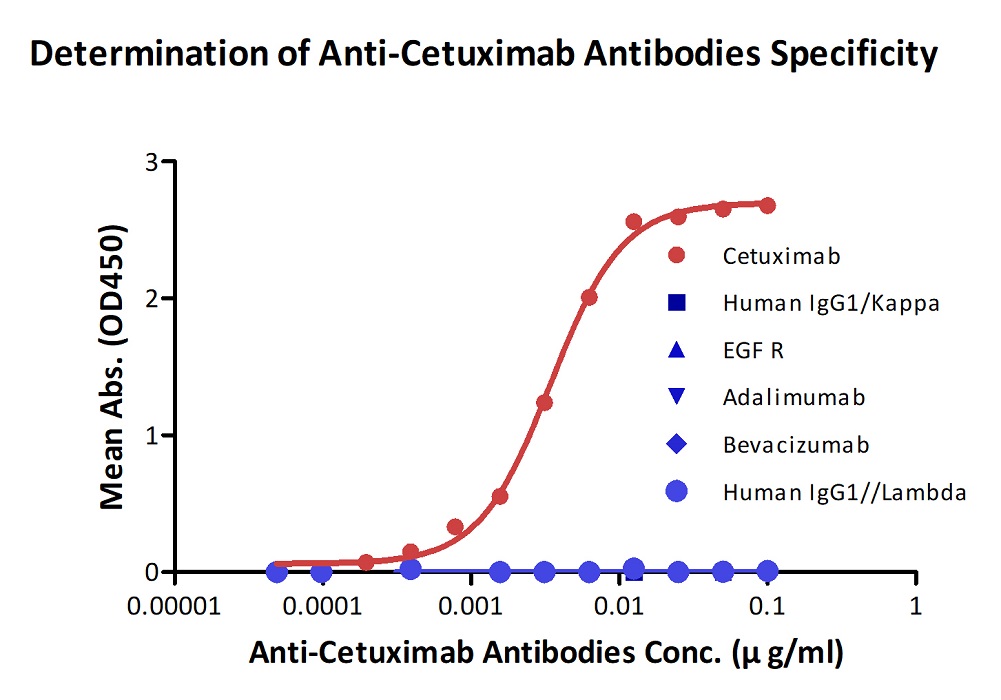
Demonstration of the specificity of Anti-Cetuximab Antibodies (Cat. No. CEB-Y28) to the cetuximab.

Reconstituted Anti-Trastuzumab Antibodies were diluted to 0.4 mg/ml, aliquoted and placed at 37°C. Aliquots were removed from 37°C at every time and placed at 4°C along with the control. No significant loss of activity was observed.

Anti-Trastuzumab Antibodies were subjected to the indicated number of freeze-thaw cycles (FT). No significant loss of activity was observed.
Anti-Idiotypic Antibody Development Service

FAQ
How do ACROBiosystems anti-idiotypic antibody solutions support therapeutic antibody bioanalysis?
How do the requirements for anti-idiotypic antibodies differ between ADA and PK assays?
What factors should be considered when selecting an anti-idiotypic antibody for ADA assay development?
What should be considered when pairing anti-idiotypic antibodies for PK assays?
What validation data are available for ACROBiosystems anti-idiotypic antibodies?
Which assay formats have been demonstrated with ACROBiosystems anti-idiotypic antibodies?
What custom solutions are available if no off-the-shelf anti-idiotypic antibody exists for a novel therapeutic lead or bispecific construct?
What critical biophysical quality attributes make ACROBiosystems' anti-idiotypic antibodies highly reliable across multi-year clinical campaigns?
- Background
- Anti-idiotypic Antibody Products List
- Two Key Applications
- Validation Data
- Anti-Idiotypic Antibody Development Service
- FAQ