



Tools for ADC PK Analysis——Anti-payload antibodies
High affinity: Verified by ADCs binding assay
High sensitivity: Specifically recognizes small molecule toxins
Comprehensive data:Provides thorough PK validation data references.
Complete technical support: Assists in establishing PK methodologies.
Click here to view data >>
| Type | Analyte Detail | Typical Method |
|---|---|---|
| Total Antibody | Conjugated, partially unconjugated, and fully unconjugated (DAR ≥ 0) | Ligand Binding Assay |
| Conjugated Antibody | Antibody with minimum DAR ≥ 1 | Ligand Binding Assay |
| Antibody-conjugated Drug | Total small-molecule drug conjugated to Antibody | Affinity LC-MS / Ligand Binding Assay |
| Unconjugated Drug | Small molecule drug not conjugated to antibody | LC-MS |
| Total Drug | Total unconjugated and conjugated Drug | LC-MS |
ADC molecule type and typical analytical methods for evaluation. 1

Different LBA formats to analyze ADCs in serum 2
Product List
| Cat. No. | Molecule | Product Description | Order Now |
|---|---|---|---|
 Order Order | |||
| Order | |||
| Order | |||
| Order | |||
| Order | |||
| Order | |||
| Order | |||
| Order | |||
| Order | |||
| Order | |||
| Order | |||
| Order | |||
| Order | |||
| Order | |||
| Order | |||
| Order | |||
| Order | |||
| Order | |||
| Order | |||
| Order | |||
| Order | |||
| Order | |||
| Order | |||
| Order | |||
| Order | |||
| Order | |||
| Order | |||
| Order | |||
| Order | |||
| Order | |||
| Order | |||
| Order | |||
| Order | |||
| Order | |||
| Order | |||
| Order | |||
| Order | |||
| Order | |||
| Order | |||
| Order | |||
| Order | |||
| Order | |||
| Order | |||
| Order | |||
| Order | |||
| Order | |||
| Order | |||
| Order | |||
| Order | |||
| Order | |||
| Order | |||
| Order | |||
| Order | |||
| Order | |||
| Order |
Assay Data

Immobilized Mouse Anti-DXD&Exatecan Antibody, Mouse IgG1, mAb (Cat. No. DXD-M684) at 1 μg/mL, add Trastuzum*b deruxtecan in the 50% Human serum and then add Biotinylated Human Her2, His,Avitag, premium grade (Cat. No. HE2-H82E2) at 0.5 μg/mL. Detection was performed using HRP-conjugated Streptavidin (Acro, Cat. No. STN-NH913) (Routinely tested).

Immobilized Human Her2, His Tag (Cat. No. HE2-H5225) at 1 μg/mL, add Trastuzum*b Deruxtecan in the 100% Human Serum and then add Biotinylated Anti-DXD Antibody, Mouse IgG1, Avitag (Cat. No. DXD-BVM807) at 0.05 μg/mL. Detection was performed using HRP-conjugated Streptavidin (Acro, Cat. No. STN-NH913) (QC tested).

Immobilized Mouse Anti-MMAE&MMAF Antibody, Mouse IgG1 (Cat. No. MME-M5252) at 5 μg/mL, add Disitamab Vedotin (RC48) in the 50% Mouse serum and then add Biotinylated Human Her2, His,Avitag, premium grade (Cat. No. HE2-H82E2) at 0.5 μg/mL. Detection was performed using HRP-conjugated Streptavidin (Acro, Cat. No. STN-NH913) (Routinely tested).

Immobilized Monoclonal Anti-DM-1&DM-4 Antibody, Mouse IgG1 (Cat. No. DM1-Y73) at 5 μg/mL, add Trastuzum*b-DM1 in the 50% Human serum and then add Biotinylated Human Her2, His,Avitag, premium grade (Cat. No. HE2-H82E2) at 0.5 μg/mL. Detection was performed using HRP-conjugated Streptavidin (Acro, Cat. No. STN-NH913) (Routinely tested).

The purity of Monoclonal Anti-DXD&Exatecan Antibody, Mouse IgG1 (Cat. No. DXD-M684) is more than 90% and the molecular weight of this protein is around 135-160 kDa verified by SEC-MALS.

The purity of Monoclonal Anti-MMAE&MMAF Antibody, Mouse IgG1 (Cat. No. MME-M5252) is more than 90% and the molecular weight of this protein is around 134-163 kDa verified by SEC-MALS.

Immobilized ADC-DXD at 1 μg/mL (100 μL/well) can bind Mouse Anti-DXD&Exatecan Antibody, Mouse IgG1, mAb (Cat. No. DXD-M684) with a linear range of 0.1-4 ng/mL (Routinely tested).

Immobilized Disitamab Vedotin (RC48) at 0.2 μg/mL (100 μL/well) can bind Monoclonal Anti-MMAE&MMAF Antibody, Mouse IgG1 (Cat. No. MME-M5252) with a linear range of 0.1-2 ng/mL (QC tested).

Immobilized ADC-DM4 at 2 μg/mL (100 μL/well) can bind Monoclonal Anti-DM-1&DM-4 Antibody, Mouse IgG1 (Cat. No. DM1-Y73) with a linear range of 0.20-6.25ng/mL (Routinely tested).

Immobilized ADC-DXD at 1 μg/mL (100 μL/well) can bind HRP conjugated Mouse Anti-DXD&Exatecan Antibody, Mouse IgG1 (Cat. No. DXD-PLM684) with a linear range of 0.5-31 ng/mL (Routinely tested).
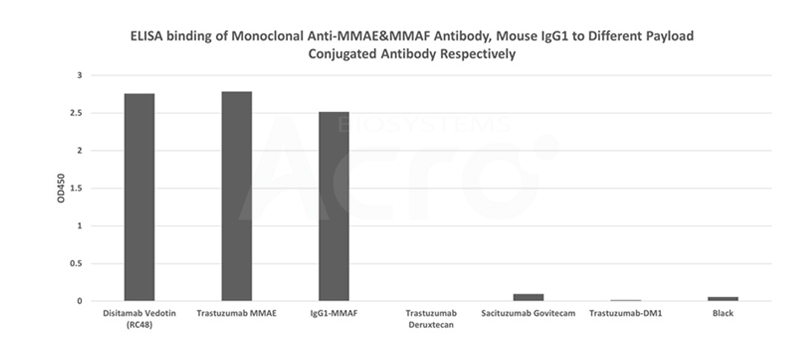
ELISA binding of Monoclonal Anti-MMAE&MMAF Antibody, Mouse IgG1 (Cat. No. MME-M5252) with Trastuzumab Deruxtecan, IgG1-MMAF, Sacituzumab Govitecan, Disitamab Vedotin (RC48), Trastuzumab MMAE and Trastuzumab-DM1 conjugated antibody respectively. The coating antibody was Monoclonal Anti-MMAE&MMAF Antibody, Mouse IgG1 (Cat. No. MME-M5252), used at 1 μg/mL concentration. The primary antibody were different payload conjugated antibodies, including Trastuzumab Deruxtecan, IgG1-MMAF, Sacituzumab Govitecan, Disitamab Vedotin (RC48), Trastuzumab MMAE and Trastuzumab-DM1 conjugated antibodies used at 0.5 μg/mL concentration. The secondary antibody was Peroxidase AffiniPure Goat Anti-Human IgG, Fcγ fragment specific (min X Bov, Hrs, Ms Sr Prot) (Jackson, Cat. No. 109-035-098) used at 1:12000 concentration. Monoclonal Anti-MMAE&MMAF Antibody, Mouse IgG1 (Cat. No. MME-M5252) is specific to Disitamab Vedotin (RC48), Trastuzumab MMAE and IgG1-MMAF, and has no cross-reactivity with Trastuzumab Deruxtecan, Sacituzumab Govitecan and Trastuzumab-DM1 (Routinely tested).
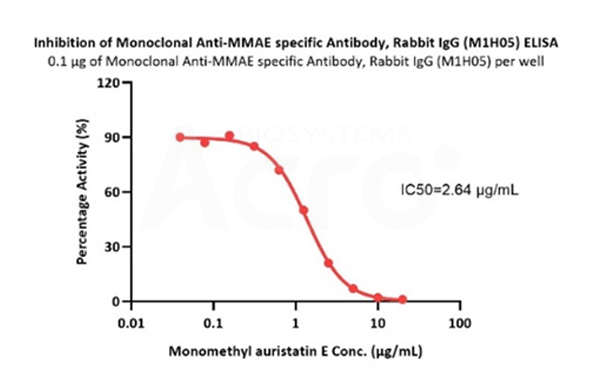
Serial dilutions of Monomethyl auristatin E were added into Monoclonal Anti-MMAE specific Antibody, Rabbit IgG (M1H05) (Cat. No. MME-MY2198a.): Disitamab Vedotin (RC48) binding reactions. The half maximal inhibitory concentration (IC50) is 2.642 μg/mL (Routinely tested).
Anti-Idiotypic Antibody and Development Service

Hardware Strength
Through the international AAALAC certification, we can standardize the management and use of animals to ensure the quality of antibodies.

Efficient Project Management
Dedicated one-on-one service with our project team with fast response and follow-up.

High Quality Materials
Key reagents for PK/ADA analysis are provided

Multifunctional Service
Services starting from antigen preparation to monoclonal / polyclonal anti-idiotype antibody development and PK/immunogenicity testing kit development.

Compliant with Regulatory Guidelines
We ensure that our PK/ADA test kits are delivered with sensitivity that meets regulatory requirements.
Resources
Webinar playback and appointment
‘ADC Potency Analysis and Quality Control Technology Breakthrough’ Webinar Series
ACROBiosystems proudly presents the flagship 'ADC Potency Analysisand Quality Control Technology Breakthrough' live webinar series. This series will systematicallydeconstruct critical aspects ofADC drug development through five coremodules-from potency analysis to quality control technologiesempowering breakthroughs in ADC therapeutics by overcoming keytechnical bottlenecks.

Addressing Challenges in Antibody-Drug Conjugate Development
Here is the brief recap of the webinar:ADCs have the potential to enable 'precision medicine' with a wide market reach.Challenges in ADCs include managing Target Affinity, enhancing payload conjugation, and assessing Payload Delivery in vivo Pharmacokinetics. We can provide high-quality solutions to address these challenges.

Building the Perfect Antibody-based Therapeutic from Selection to Engineering and Manufacturing
In this webinar, discover how advanced techniques such as Al-driven candidate selection optimization of antibody sequences, and precise conjugation methods come together to address some of the current challenges in antibody-based therapeutics.

Brochure Download



Poster/Application Note Download


Promotion


References
1. Gorovits, B. et al. Bioanalysis of antibody-drug conjugates: American Association of Pharmaceutical Scientists Antibody-Drug Conjugate Working Group position paper. Bioanalysis 5, 997–1006 (2013).
2. Qin, Q. & Gong, L. Current Analytical Strategies for Antibody–Drug Conjugates in Biomatrices. Molecules 27, 1–17 (2022).
FAQ
What ADC analyte can be measured using an anti-payload antibody?
Does an anti-payload antibody recognize free payload and payload-conjugated ADC in the same way?
How should different anti-payload antibody clones be compared for ADC PK assay development?
When should unconjugated, biotinylated, or HRP-conjugated anti-payload antibodies be used?
Can ACROBiosystems anti-payload antibodies be used to quantify ADCs in serum?
Are anti-payload antibody screening panels available for clone selection?
What conjugate options are available for anti-payload antibodies to support direct and indirect ELISA workflows?
How does ACROBiosystems support end-to-end bioanalytical method development for ADC PK and immunogenicity testing?
- Background
- Product List
- Assay Data
- Anti-Idiotypic Antibody and Development Service
- Resources
- Promotion
- FAQ