Have you noticed that NTD could be a pivotal player during infection?
 Publication Date:2021-03-12
 Page Views:6150
Multiple variants of SARS-CoV-2 are circulating around the world and becoming a pressing concern. As scientists are working to learn more about the altered transmissibility, pathogenicity and elevated risks of immune escape that are characteristic of these variants, recombinant protein antigens are indispensable tools to conduct research and development.
In a typical scenario, post-vaccination serums are tested against the variant antigens for evaluation of the effectiveness of currently authorized vaccines.
Most of the commercially available protein antigens are receptor binding domain (RBD) of the SARS-CoV-2 spike protein because of RBD’s well-recognized role in mediating viral binding. However, studies show that N-terminal domain (NTD) of the spike protein could also be a critical candidate epitope.1
In a recent study, the UK and South African variants, both with significant number of mutations and deletions on the NTD, abrogated activity of almost all neutralizing NTD-directed mAbs. While South African variant containing 3 mutations in the RBD markedly reduced neutralizing activity of only several mAbs against RBDs2. Additionally, analysis of patients with long-term infection showed SARS-CoV-2 regularly acquiring recurrent deletion in NTD enabling immune escape3. These new findings point to NTD as a pivotal player during infection and antibody resistance.
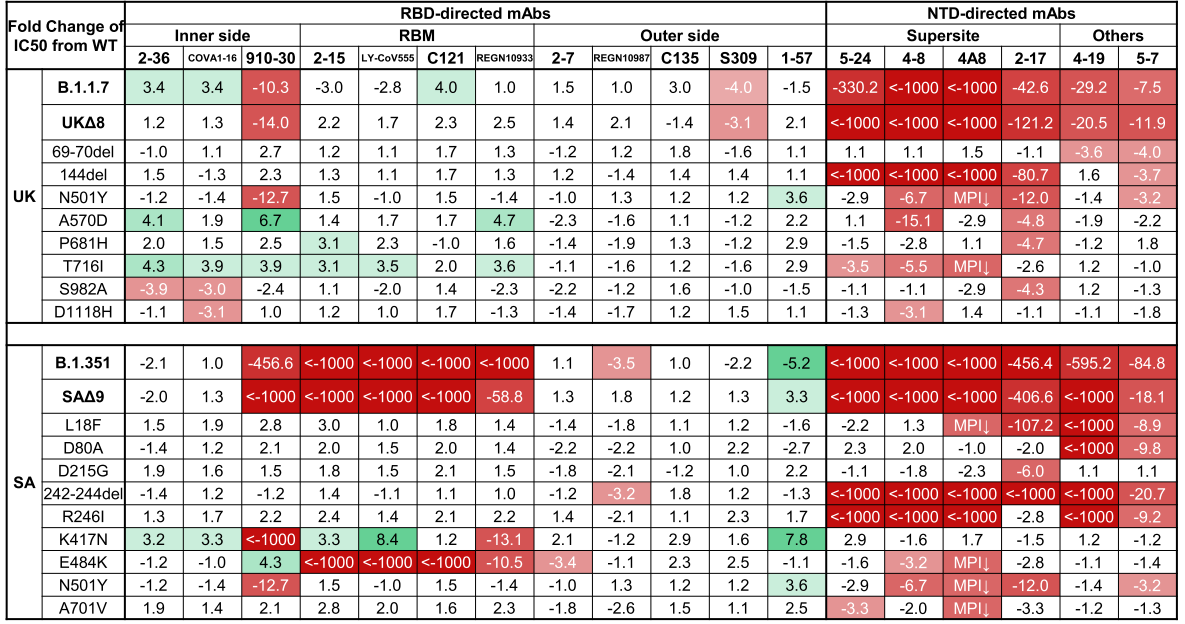
While NTD of SARS-CoV-2 does not bind to ACE2 directly, its function in SARS-CoV-2 infection remains unclear. It is also not well-understood how NTD-directed antibodies block SARS-CoV-2 infection. Due to UK, South African and Brazilian variant containing several, similar NTD mutations and deletions, future target for vaccines and therapeutics should be directed towards NTD along with RBD of spike protein.
Related article: Potential target for SARS-CoV-2: N terminal domain of S1 Protein
ACROBiosystems believes that the progress on NTD research should not be held back by the limited availability of research reagents. Therefore, we have developed 8 NTD-based recombinant proteins with different mutations to satisfy the diverse research needs of our customers.
Reference
1 Liu, L., Wang, P., Nair, M.S. et al. Potent neutralizing antibodies against multiple epitopes on SARS-CoV-2 spike. Nature 584, 450–456 (2020).https://doi.org/10.1038/s41586-020-2571-7
2 Wang, P., Nair, M.S., Liu, L. et al. Antibody Resistance of SARS-CoV-2 Variants B.1.351 and B.1.1.7. Nature (2021).https://doi.org/10.1038/s41586-021-03398-2
3 McCarthy, K. R., Rennick L. J., Nambulli S. et al. Recurrent deletions in the SARS-CoV-2 spike glycoprotein drive antibody escape. Science (2021).https://science.sciencemag.org/content/early/2021/02/02/science.abf6950/tab-pdf
 Popular ArticlesRelated RecommendationsPopular Events
 AI-Assisted Bispecific Antibody Development: From Target Pairing Prediction to Experimental Validation2026-07-31Page Views:52
 The Brain's Fountain of Youth: How Modern Neuroscience Is Decoding Healthy Brain Aging2026-07-31Page Views:22
 In Vivo CAR-T Therapy: Next-Generation CAR-T Cell Engineering and Gene Delivery Advances2026-07-29Page Views:47
 A Comprehensive Guide to Sterility Testing in Biopharmaceutical Manufacturing: From Compendial Methods to qPCR-Based Rapid Testing2026-07-27Page Views:67
 Biomarkers: Enabling Precision Assessment of Cardio-Kidney-Metabolic (CKM) Syndrome2026-07-24Page Views:97





 Related Products