Overview of Fc Receptors: classification and functions
 Publication Date:2021-10-20
 Page Views:25563
Fc receptors (FcRs) are a group of glycoproteins belonging to the immunoglobulin superfamily and are organized into classes, such as Fc alpha receptors (FcαRs), Fc gamma receptors (FcγRs) and Fc epsilon receptors (FcεRs). Communication of IgG antibodies with the immune system is controlled and mediated by FcγRs, which relay the information sensed and gathered by antibodies to the immune system. IgG is the most studied and best characterized of the Igs and is divided into four distinct subclasses (IgG1, IgG2, IgG3, IgG4), each with differences in sequence and structure, binding properties to FcγRs and effector functions.
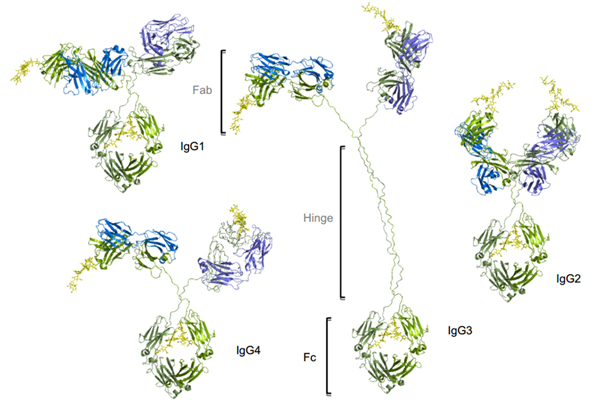 Figure1. Four subtypes of IgG exist in humans: IgG1, IgG2, IgG3, IgG4. Conserved Asn 297 amino acids in the Fc region with N-glycans attached (shown in yellow), Heavy chains are shown in green, and light chains are shown in blue and purple.
The four subtypes are named based on their respective abundance in serum with IgG1 being the most abundant. IgG antibodies consist of two Fab regions that can bind both an antigen molecule and the Fc region which interact with the FcγRs, joined by a highly flexible hinge region. IgG1 has the highest affinity to all FcγRs, leading to significant effector functions, such as ADCC, ADCP, and CDC. Although human IgG3 can also mediate competent effector functions, it has a very long hinge region and complex disulfide bonds, resulting in significantly greater polymorphism, which may increase the risk of immunogenicity. Therefore, the IgG3 isotype is rarely chosen in antibody therapeutics. In comparison, IgG2 and IgG4 induce significantly weaker or no ADCC and CDC.
Based on the differences in structure, function, and affinity for IgG binding, FcγRs are classified into three major groups: FcγRI/CD64, FcγRII/CD32 (FcγRIIa, FcγRIIb and FcγRIIc) and FcγRIII/CD16 (FcγRIIIa and FcγRIIIb). Among them, FcγRI, FcγRIIa, and FcγRIIIa are activating receptors containing the signal transduction motif, immunoreceptor tyrosine-based activation motif (ITAM), in the γ subunit of FcγRI and FcγRIIIa, or in the cytoplasmic tail of FcγRIIa. In contrast, FcγRIIb is an inhibitory receptor. Cross-linking of FcγRIIb leads to the phosphorylation of the immunoreceptor tyrosine-based inhibitory motif (ITIM) and inhibitory signaling transduction.
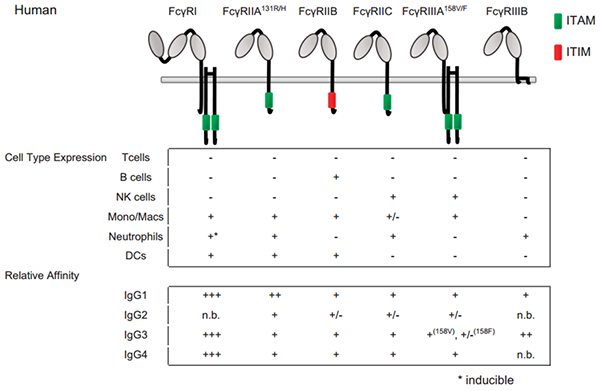 Figure 2 Fc–FcγRs interactions and FcγRs expression across cell subsets in human.
For cell-type expression, + indicates constitutive expression, +* indicates inducible expression and − indicates no expression. For relative affinities, +++ indicates lower than 1 μM, ++ indicates 1–10 μM, + indicates 10–100 μM, +/− indicates higher than 100 μM and n.b. indicates no binding. †Indicates binding observed with no affinity reported.
Figure 2 Fc–FcγRs interactions and FcγRs expression across cell subsets in human.
For cell-type expression, + indicates constitutive expression, +* indicates inducible expression and − indicates no expression. For relative affinities, +++ indicates lower than 1 μM, ++ indicates 1–10 μM, + indicates 10–100 μM, +/− indicates higher than 100 μM and n.b. indicates no binding. †Indicates binding observed with no affinity reported.
FcγRI (Fc gamma receptor I, CD64)
FcγRI is a high-affinity Fc receptor for both the monomeric IgG and immune complex (IC). The affinities of FcγRI to IgG1 or IgG4 are similar (1–10 nM KD). In contrast, FcγRI has no binding to IgG2. FcγRI is mainly expressed on monocytes/macrophages, dendritic cells (DCs), and activated neutrophils. One of the major functions of FcγRI is to activate myeloid cells to phagocytose IgG1 and IgG-bound target cells via ADCP. Due to high-affinity binding of FcγRI to monomeric IgG and high serum concentrations of IgG (∼15 mg/mL), it is believed that most FcγRI is occupied by endogenous IgG. However, a recent study has shown that stimulation of myeloid cells with cytokines, such as tumor necrosis factor-α (TNF-α) and interferon-γ (IFN-γ), could induce the clustering of FcγRI and increase the binding of FcγRI to ICs. Multiple studies have also shown that FcγRI plays an important role in modulating immune responses in autoimmune diseases, inflammation, and antibody therapy.
FcγRII (Fc gamma receptor II, CD32)
FcγRII is the receptor most widely expressed on hematopoietic cells among FcγRs. FcγRII includes FcγRIIA, FcγRIIB and FcγRIIC isoforms. FcγRIIA, expressed on monocytes, macrophages, neutrophils, and platelets is more largely expressed on immune cells than FcγRIIC that has been identified on NK cells. FcγRIIA initiates endocytosis, phagocytosis, ADCC, and inflammatory mediator release. By contrast, FcγRIIB, expressed on B cells, basophils, mast cells, monocytes, macrophages and DC transduce inhibitory signals that down-regulate immune functions triggered by activating receptors, when co-ligated with the latter receptors.
FcγRIII (Fc gamma receptor III, CD16)
Two different FcγRIII isoforms have been identified. FcγRIIIB is a glycosyl-phosphatidylinositol (GPI) anchored- FcγRIIIB expressed on neutrophils and involved in degranulation and generation of reactive oxygen intermediates by these cells. FcγRIIIA is a transmembrane isoform expressed on NK cells and a small subpopulation of T lymphocytes as well as on monocytes and macrophages, although at low levels in the latter case. FcγRIIIA is involved in ADCC, phagocytosis, endocytosis and cytokine release.
While the mouse IgG system differs from the human in important ways (mice express IgG1, IgG2a, IgG2b and IgG3, all with different affinities for mouse FcγRs compared with human), with higher affinity Fc–FcγRs engagement by the mouse IgG2a isotype for activating FcγRs than that of human IgG1.
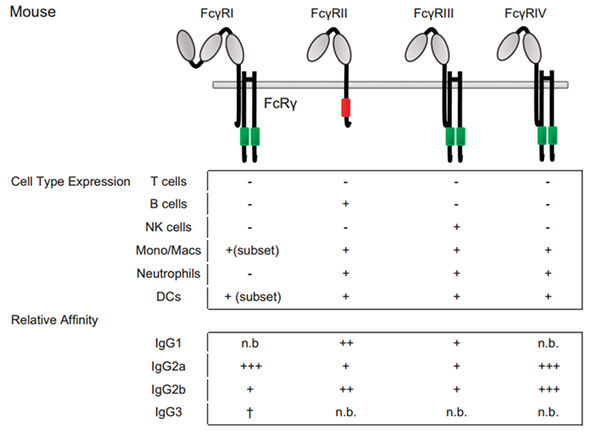 Figure 3 Fc–FcγRs interactions and FcγRs expression across cell subsets in mouse.
For cell-type expression, + indicates constitutive expression, +* indicates inducible expression and − indicates no expression. For relative affinities, +++ indicates lower than 1 μM, ++ indicates 1–10 μM, + indicates 10–100 μM, +/− indicates higher than 100 μM and n.b. indicates no binding. †Indicates binding observed with no affinity reported.
Figure 3 Fc–FcγRs interactions and FcγRs expression across cell subsets in mouse.
For cell-type expression, + indicates constitutive expression, +* indicates inducible expression and − indicates no expression. For relative affinities, +++ indicates lower than 1 μM, ++ indicates 1–10 μM, + indicates 10–100 μM, +/− indicates higher than 100 μM and n.b. indicates no binding. †Indicates binding observed with no affinity reported.In mice, only FcγRI, FcγRIIB, and FcγRIIIA human equivalents have been described. Mouse FcγRI and FcγRIIIA (termed FcγRIII) exhibit the same activating properties as their human counterparts. These two mouse receptors bind IgG with a high and a low affinity, respectively. Mouse FcγRIIB (termed FcγRII) is also a low affinity receptor that exhibits inhibitory functions as the human FcγRIIB that contains an ITIM. All mouse FcγRs can bind human IgG1 and IgG3 subclasses, in addition to mouse IgG1, IgG2a, and IgG2b subclasses. Among these subclasses, IgG2a is a strong binder of FcγRI, as compared to IgG1 and IgG2b which preferentially bind FcγRIIB and FcγRIII, to which IgG2a also binds. Whether a specific mouse Fc receptor for mouse IgG3 exists is still a matter of controversy, although it has been claimed that this subclass could bind mouse FcγRI.
Summary
FcγRs are expressed mostly on leukocytes and they are the class of receptors most relevant for the function of therapeutic antibodies. FcγRs are divided into three types, FcγRI (CD64), FcγRII (CD32) and FcγRIII (CD16). They have traditionally been categorized according to their affinity for specific IgG subclasses and the type of signaling pathway that they trigger; that is, whether it is inhibitory or activating. In general, FcγRI has been considered to be a high-affinity receptor that binds both monomeric IgG and immune complexes, whereas the affinity of FcγRII and FcγRIII for IgGs is low and intermediate, respectively.
Engineering the Fc region of IgG mAbs or IgG-like bispecific antibodies to modulate IgG/FcγRs interactions is a major goal of current studies on therapeutic antibodies. The development and manufacture of therapeutic antibodies, including Fc (crystallizable fragment) fusion proteins, represent a significant segment of the biopharmaceutical industry and have resulted in substantial benefits to public health. In conclusion, binding of the antibody Fc-hinge region to FcγRs has been shown to exert a profound impact on antibody function and in vivo efficacy.
ACROBiosystems offers a comprehensive collection of recombinant Fc receptor proteins, including their common variants, to expedite your antibody drug development.
The use of biotin labeling can make your assay development much easier. We offer a variety of “ready-to-use” biotinylated Fc receptors. These proteins are produced using our in-house developed labeling techniques, which confers high bioactivity and minimal batch-to-batch variation. In addition, we have developed a series of Fc receptors of other species, which are suitable for the screening of non-humanized antibodies or the species cross reaction.
 Expressed by HEK293 Cells: post-translational modification and proper protein folding
Multiple species: Human, Mouse, Cynomolgus/Rhesus macaque, Rat, Porcine, Rabbit, Feline, Bovine, can be fully applied to different cross species experiments
High purity: SDS-PAGE verification purity>95%, SEC-MALS verification purity>90%
Low endotoxin: <1.0 EU/µg
High stability: strict quality control to ensure high batch-to-batch consistency
Biotinylated Fc Receptor proteins labeled with AvitagTM offered: the labeling efficiency is high, and the labeling site is specific and clear, which is suitable for ELISA/SPR/BLI detection based on binding to streptavidin in the process of drug development and optimization process
Affinity verified by SPR & BLI: activity guaranteed, and protocols offered free of charge
More Fc Receptors related information
>>> Why Fc Receptors Are So Important?
>>> Role of FcRn as a therapeutic target
References
1. Jerrard M Hayes, Mark R Wormald et al. Fc gamma receptors: glycobiology and therapeutic prospects. Journal of Inflammation Research. 2016, 9:209–219.
2. Bryan C Barnhart, Michael Quigley. Role of Fc–FcγR interactions in the antitumor activity of therapeutic antibodies. Immunology and Cell Biology. 2017, 95, 340–346.
3. Gestur Vidarsson, Gillian Dekkers. IgG subclasses and allotypes: from structure to effector functions. Frontiers in Immunology.2014, 5(520).
4. Sophie Siberil, Charles-Antoine Dutertre et al. FcγR: The key to optimize therapeutic antibodies? Critical Reviews in Oncology/Hematology. 2007, 62,26–33.
5. Xin Chen, Xiaomin Song et al. FcγR-Binding Is an Important Functional Attribute for Immune Checkpoint Antibodies in Cancer Immunotherapy. Frontiers in Immunology.2019,10.
6. Xu-Rong Jiang, An Song et al. Advances in the assessment and control of the effector functions of therapeutic antibodies. Nature Review, Drug Discovery.2011,10.
 Popular ArticlesRelated RecommendationsPopular Events
 Application-Oriented Functional Cell Lines | Case Study Series2026-08-03Page Views:54
 AI-Assisted Bispecific Antibody Development: From Target Pairing Prediction to Experimental Validation2026-07-31Page Views:78
 The Brain's Fountain of Youth: How Modern Neuroscience Is Decoding Healthy Brain Aging2026-07-31Page Views:43
 In Vivo CAR-T Therapy: Next-Generation CAR-T Cell Engineering and Gene Delivery Advances2026-07-29Page Views:122
 A Comprehensive Guide to Sterility Testing in Biopharmaceutical Manufacturing: From Compendial Methods to qPCR-Based Rapid Testing2026-07-27Page Views:85




 Related Products