Independent Eurofins Validation Confirms rFC Endotoxin Testing Performance and LAL Comparability
 Publication Date:2026-06-17
 Page Views:334
How Third-Party Validation Supports rFC Adoption for Biologics Quality Control
Bacterial endotoxin testing (BET) is a critical quality control requirement for biologics, vaccines, cell therapies, gene therapies, and sterile pharmaceutical products. From monoclonal antibodies and recombinant proteins to vaccines, cell therapies, and gene therapies, endotoxin testing plays a direct role in product safety evaluation and batch release decisions.
For decades, Limulus Amebocyte Lysate (LAL)-based assays have served as the industry standard. However, increasing manufacturing complexity, heightened regulatory expectations, and growing interest in sustainable quality control practices have accelerated the adoption of recombinant technologies.
Among these innovations, recombinant Factor C (rFC) has emerged as a scientifically robust alternative for endotoxin detection. Unlike traditional LAL reagents, which contain multiple clotting factors derived from horseshoe crab blood, rFC specifically utilizes recombinant Factor C to detect endotoxin from Gram-negative bacteria. This targeted mechanism eliminates β-glucan-mediated interference associated with the Factor G pathway and contributes to improved assay specificity and consistency.
Regulatory acceptance of rFC has expanded significantly in recent years. The implementation of USP <86> Bacterial Endotoxins Test Using Recombinant Reagents and the publication of EP 2.6.32 Bacterial Endotoxin Detection Using Recombinant Factor C have established rFC as a compendial endotoxin testing method.
Nevertheless, regulatory recognition alone is rarely sufficient for implementation. Biopharmaceutical manufacturers typically require independent analytical validation data to assess method suitability, comparability to existing LAL workflows, and potential integration into established quality control systems.
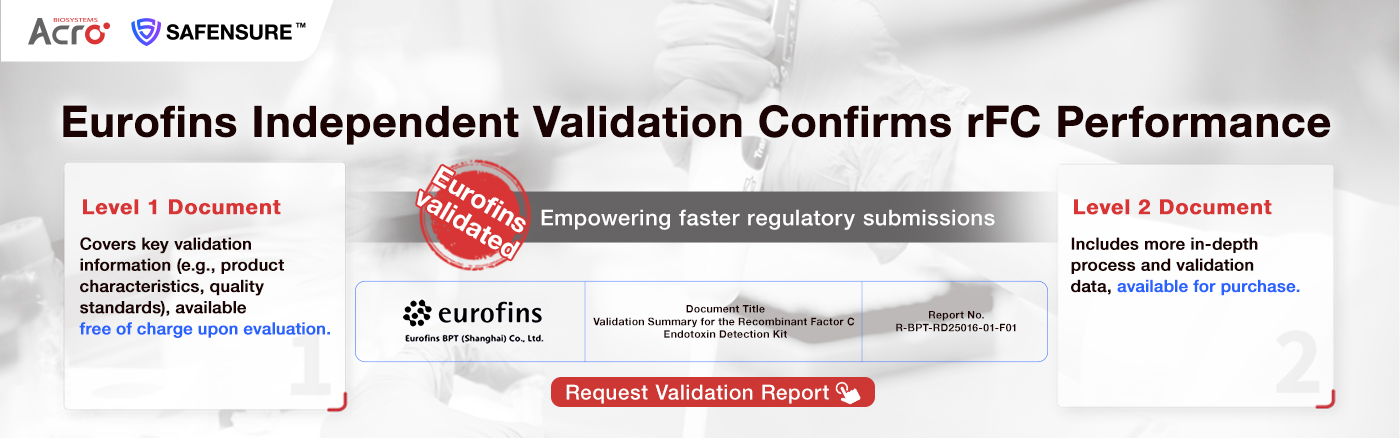
To provide additional evidence supporting rFC adoption, ACROBiosystems commissioned an independent third-party validation study of the SAFENSURE™ Recombinant Factor C Endotoxin Testing Kit (RES-A056) through Eurofins BPT Shanghai.
Why Independent Validation Matters for rFC Implementation
When evaluating a new endotoxin testing platform, quality control laboratories generally focus on several key questions:
- Does the method demonstrate sufficient sensitivity and specificity?
- Is analytical performance consistent and reproducible?
- Can results be correlated with existing LAL methods?
- Does the assay perform reliably across different endotoxin sources and sample matrices?
- Are validation data generated according to recognized pharmacopeial and analytical guidelines?
Independent validation provides objective evidence to answer these questions and reduces uncertainty during method bridging, comparability studies, and technology transfer activities.
For organizations considering a transition from LAL to recombinant technologies, third-party validation data can significantly strengthen technical assessments and internal decision-making processes.
Eurofins Independent Validation Study Overview
The SAFENSURE™ Recombinant Factor C Endotoxin Testing Kit (RES-A056) underwent an independent analytical validation study conducted by Eurofins BPT Shanghai.
The evaluation was performed in accordance with relevant pharmacopeial requirements and internationally recognized analytical method validation principles, including:
- USP <1225> Validation of Compendial Procedures
- ICH Q2(R2) Validation of Analytical Procedures
- USP <85> Bacterial Endotoxins Test
- USP <86> Bacterial Endotoxins Test Using Recombinant Reagents
- EP 2.6.14 Bacterial Endotoxins
- EP 2.6.32 Bacterial Endotoxin Detection Using Recombinant Factor C
The study assessed critical performance characteristics including sensitivity, accuracy, precision, specificity, matrix interference, and comparability to conventional LAL methods. Results demonstrated that the assay met predefined acceptance criteria across all evaluated parameters.
 Demonstrated Comparability to Traditional LAL Methods
One of the most important considerations when adopting rFC technology is demonstrating comparability with established LAL-based testing procedures.
As part of the Eurofins validation study, parallel testing was performed using USP Reference Standard Endotoxin and endotoxin samples from multiple sources.
Key findings included:
- Result ratios between rFC and LAL ranged from 0.64 to 1.85
- All results met the pharmacopeial comparability criterion of 0.5–2.0-fold
- USP endotoxin recovery ranged from 58.7% to 97.0%
- Recovery values remained within the accepted pharmacopeial range of 50%–200%
These findings indicate that the SAFENSURE™ rFC assay delivers performance comparable to conventional LAL methodologies and can provide a reliable foundation for method bridging and replacement studies.
For laboratories seeking to transition toward recombinant reagent-based endotoxin testing, such comparability data are essential for risk assessment and implementation planning.
High Specificity Through Selective Endotoxin Recognition
Specificity is another critical attribute of endotoxin detection methods.
Traditional LAL assays may respond to β-glucans through activation of the Factor G pathway, potentially generating non-specific signals and increasing the risk of false-positive results.
Because recombinant Factor C directly targets endotoxin recognition, it avoids this biological limitation.
During Eurofins validation, β-glucan challenge testing demonstrated that the SAFENSURE™ assay generated no detectable endotoxin-positive response in the absence of endotoxin contamination.
This result further confirms the endotoxin-specific detection mechanism of rFC technology and highlights its potential advantages when testing complex biological matrices where non-specific interference can be a concern.
Additional Validation Highlights
Beyond comparability and specificity, the validation study confirmed strong analytical performance across multiple parameters.
- Sensitivity: Limit of Quantitation (LOQ): 0.005 EU/mL
- Accuracy: Recovery results met pharmacopeial acceptance criteria of 50%–200%
- Precision: Repeatability and intermediate precision both satisfied the acceptance requirement of RSD ≤ 20%
- Matrix Interference Assessment: Interference studies passed validation requirements. Recovery remained within the accepted pharmacopeial range of 50%–200%
Collectively, these results demonstrate that the assay provides the sensitivity, reproducibility, and robustness required for modern biopharmaceutical quality control applications.
Supporting Reliable Endotoxin Testing in Advanced Biopharmaceutical Manufacturing
As biologics pipelines continue to expand, endotoxin testing requirements are becoming increasingly demanding. At the same time, regulatory agencies and pharmacopeias are encouraging the adoption of scientifically justified recombinant alternatives.
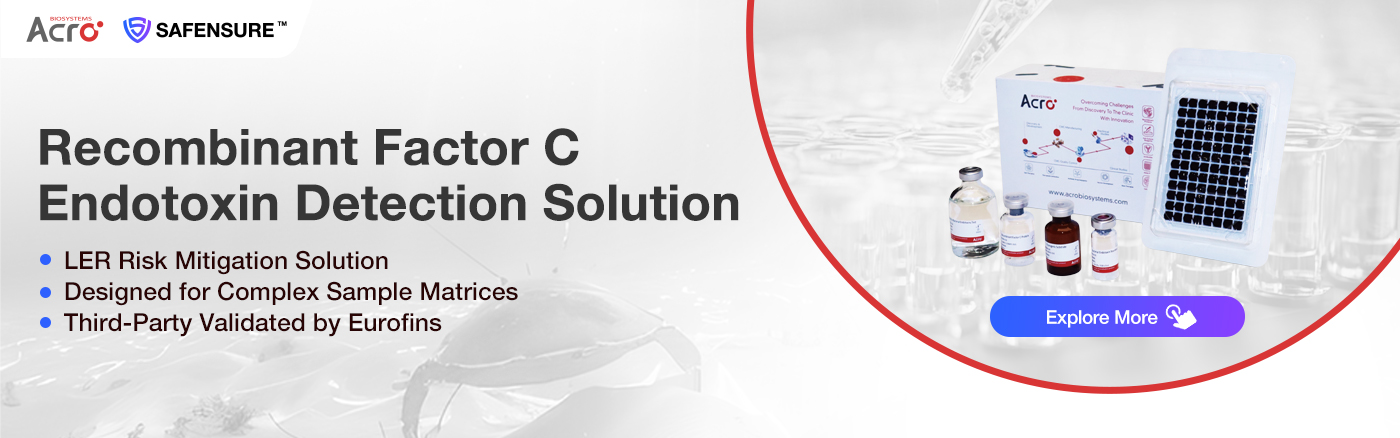
The SAFENSURE™ Recombinant Factor C Endotoxin Testing Kit utilizes endpoint fluorescence detection to enable sensitive and specific bacterial endotoxin quantification. Developed with recombinant Factor C technology, the assay enables rapid and accurate bacterial endotoxin detection with high sensitivity, specificity, and lot-to-lot consistency.
To support reliable testing in complex samples, we also provide key ancillary reagents and consumables, including an LER Demasking Buffer designed to mitigate Low Endotoxin Recovery (LER) effects and Endotoxin-Free Glass Test Tubes, helping reduce matrix interference and improve detection reliability.
Conclusion
The growing regulatory acceptance of recombinant reagents is reshaping the future of bacterial endotoxin testing. However, successful implementation requires more than regulatory recognition—it requires robust analytical evidence.
The independent validation conducted by Eurofins BPT Shanghai demonstrated that the SAFENSURE™ Recombinant Factor C Endotoxin Testing Kit achieved strong performance in sensitivity, specificity, accuracy, precision, matrix interference assessment, and comparability to conventional LAL methods.
These data provide valuable support for organizations evaluating rFC-based endotoxin testing strategies, conducting method bridging studies, or modernizing biologics quality control programs.
As the industry continues its transition toward recombinant technologies, independent validation will remain a critical component in building confidence, reducing implementation risk, and accelerating adoption of next-generation endotoxin testing solutions.
FAQ
Q1: What Is Recombinant Factor C (rFC) Endotoxin Testing?
A: Recombinant Factor C (rFC) endotoxin testing is a bacterial endotoxin detection method that utilizes genetically engineered Factor C, the endotoxin-sensitive component of the horseshoe crab coagulation cascade. Unlike traditional LAL assays, rFC technology eliminates animal-derived clotting factors and specifically responds to endotoxin from Gram-negative bacteria.
Q2: How Does rFC Compare with Traditional LAL Methods?
A: Multiple studies, including the independent Eurofins validation described here, have demonstrated that rFC assays can achieve performance comparable to conventional LAL methods when evaluated according to pharmacopeial requirements. Key parameters typically assessed include sensitivity, recovery, precision, specificity, and method comparability.
Q3: Is rFC Accepted by Regulatory Authorities?
A: Yes. Regulatory acceptance of rFC has expanded significantly in recent years. USP <86> and EP 2.6.32 formally recognize recombinant reagent-based endotoxin testing approaches, providing a regulatory framework for the implementation and validation of rFC methods in pharmaceutical quality control laboratories.
Additional Related Resources
- Recombinant Factor C (rFC) vs LAL: A Multi-Sample Comparability Study for Endotoxin Testing
- Recombinant Factor C (rFC) vs LAL Assay: Comparability and Regulatory Trends in Endotoxin Testing
- Overcoming the LER Challenge: Mechanistic Insights and Mitigation Strategies for LER

 Popular ArticlesRelated RecommendationsPopular Events
 Application-Oriented Functional Cell Lines | Case Study Series2026-08-03Page Views:43
 AI-Assisted Bispecific Antibody Development: From Target Pairing Prediction to Experimental Validation2026-07-31Page Views:67
 The Brain's Fountain of Youth: How Modern Neuroscience Is Decoding Healthy Brain Aging2026-07-31Page Views:37
 In Vivo CAR-T Therapy: Next-Generation CAR-T Cell Engineering and Gene Delivery Advances2026-07-29Page Views:82
 A Comprehensive Guide to Sterility Testing in Biopharmaceutical Manufacturing: From Compendial Methods to qPCR-Based Rapid Testing2026-07-27Page Views:73





 Related Products